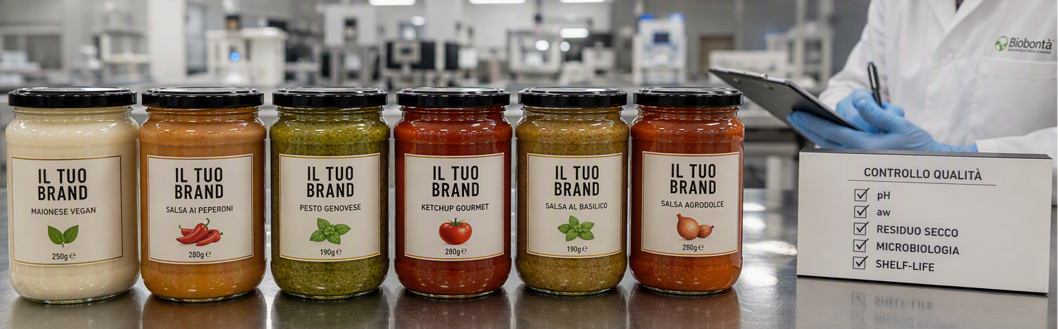
In the competitive landscape of the HoReCa and large-scale retail sectors, the success of a sauce is never a matter of chance, but rather the result of a rigorous food engineering process. When a brand turns to an industrial partner for contract manufacturing of sauces, it is looking for much more than just a contractor: it is seeking a strategic co-packer capable of guaranteeing uncompromising quality standards, microbiological safety, and perfectly consistent organoleptic properties.
At Biobontà, every product development project—whether it involves mayonnaise, gourmet ketchup, ethnic sauces, plant-based condiments, or sweet-and-sour specialties—follows a rigorous and transparent R&D protocol.
Here’s how we turn an idea into an industrial product ready to conquer international markets.
1. Project Definition and Formulation Study
Every great product begins with listening to our partner’s needs. Whether we start with a laboratory sample provided by the customer or a blank slate, our technical team begins a crucial preliminary phase:
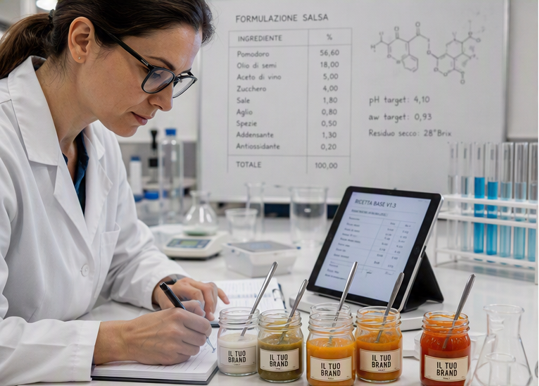
- Feasibility Analysis and 100% Recipe Formulation: We break down and balance every single ingredient.
- Formulation Cost Engineering: We optimize the formula to ensure maximum cost-effectiveness without compromising the brand’s identity and perception of high quality.
2. Study of the Technological and Chemical-Physical Context
An excellent sauce must stand the test of time and logistics. It’s not enough for it to taste good right after it’s made—it must maintain its colloidal structure and microbiological safety for months. To achieve this, we define the following with scientific precision:
Critical parameters: Stringent targets for pH, water activity, and dry matter (DM).
- Emulsion stability: In-depth evaluation of syneresis or phase separation.
- Heat treatments: Targeted design of pasteurization or hot-filling cycles.
- Predictive shelf life: Calculation of stability at both room temperature and in the cold chain (0+4°).
3. Packaging Engineering
The packaging is the first indicator of a product’s quality. Depending on the target market—retail, HoReCa, or in-flight catering—we evaluate the best packaging technologies:
- Materials: High-transparency glass, engineering plastics, or innovative single-dose solutions.
- Special Formats: Optimized closures and oxygen barriers to preserve color and flavor profiles over time.

4. Rigorous Selection of Raw Materials
Industrial quality starts with the land. We select certified, organic, strictly gluten-free, and plant-friendly supply chains. Through a network of qualified suppliers, we track every single raw material to ensure full compliance with the international standards required by the most demanding foreign markets.
5. Pilot Test: The 3 Destructive Tests in the Pilot Plant
Before scaling up industrial production, the theory is validated in the field. We conduct rigorous test cycles:
Pilot-scale preparation and cooking.
- Vacuum degassing: A crucial step for removing trapped air, preventing oxidation, and ensuring a bright color and a velvety texture.
- Bottling and thermal stabilization.
6. External Analytical and Microbiological Validation
Before presenting the final sample to our partner, we submit the product to accredited external laboratories to obtain irrefutable certifications:
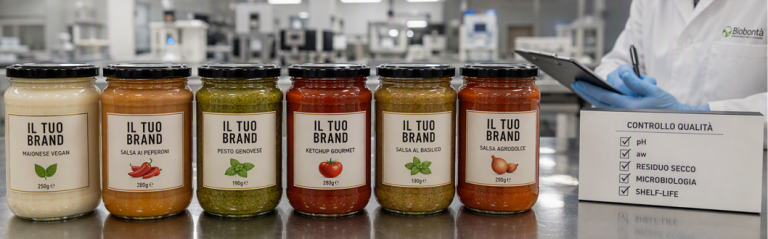
Official chemical and physical analyses (pH, aw, RS).
- Microbiological analyses: TBC (Total Bacterial Count), testing for molds and yeasts.
- Preparation of the Technical Data Sheet and Nutrition Facts Panel in accordance with current regulations for global export.
7. Accelerated Aging and Oven Stress Testing
To eliminate any commercial risk, pilot batches undergo accelerated aging cycles in thermostatic ovens. This stress test simulates months of storage under harsh temperature conditions, allowing us to certify their shelf stability even before the official market launch.
Frequently Asked Questions (FAQ) About Contract Sauce Manufacturing
What is the minimum order quantity (MOQ) for developing a new sauce on a contract basis?
Thanks to the flexibility of our pilot line and our industrial facilities, we are able to structure scalable test batches to allow our partners to test the market (retail or HoReCa) without excessive exposure, and then work together to determine the optimal production volumes.
How long does it take to research and develop a new recipe?
The complete process—which includes 100% recipe validation, analysis of chemical and physical parameters (pH, aw, RS), the three destructive tests in the pilot plant, and external microbiological validation—takes an average of 2 to 4 weeks, depending on the complexity of the matrix and the specific shelf-life requirements.
Is it possible to develop organic, gluten-free, or plant-based sauces?
Definitely yes. Our corporate philosophy and product line are inherently focused on organic, gluten-free, and clean-label plant-based formulations, using carefully selected and traceable ingredients.
How is the product's shelf life ensured?
In addition to the engineering calculations of pasteurization and hot-filling parameters and water activity, we systematically subject pilot batches to accelerated aging cycles through stress tests in an oven, simulating the most extreme thermal conditions to certify the product’s commercial stability over time.
The Ideal Partner for Your Sauce Brand
Outsourcing the formulation and production of your sauces means choosing a partner that combines the artistry of the recipe with the reliability of a certified industrial process.
Would you like to develop a new line of sauces or improve an existing product?
Contact us today to speak with our Research and Development team.