Why compare rice, soya and oats in particular?
In recent years, the food sector has undergone a profound transformation.
The demand for plant-based products is no longer limited to vegetarian or vegan consumers. More and more people are looking for foods with simple, recognisable ingredients that are in line with a wellness-oriented lifestyle.
For this reason, many companies are developing new recipes using plant-based raw materials.
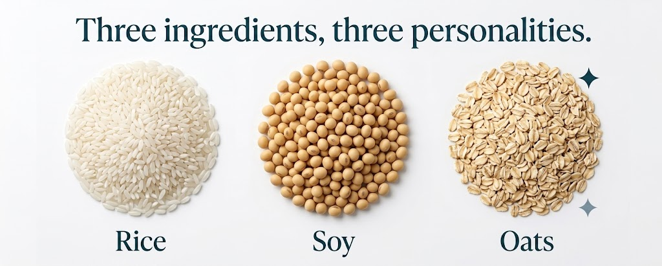
Among the most interesting are rice, soya and oats.
These are three very different ingredients.
They have different technological properties.
They convey different messages to the consumer.
They offer different opportunities to food companies.
The aim of this comparison is not to identify an overall winner.
The aim is to understand which ingredient best meets the requirements of a modern plant-based sauce.
How we carried out the comparison
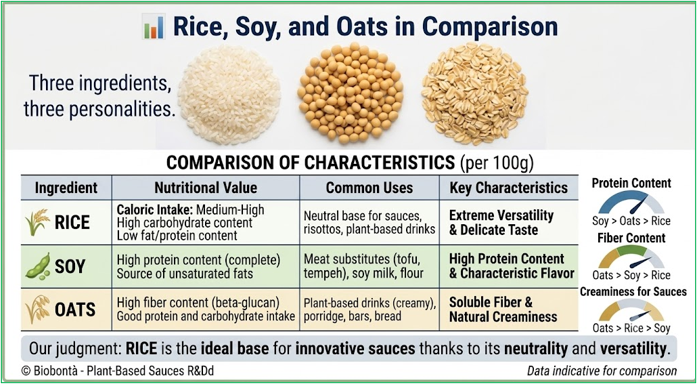
We have assessed each ingredient against seven key criteria.
- Flavour profile.
- Allergen management.
- Naturalness and gluten-free status.
- Consumer perception.
- Supply chain availability.
- Versatility in industrial applications.
- Potential for innovation.
These criteria reflect the real needs of those developing new food products, whether for the retail market, the food service sector or private label.
Round 1 – Flavour
Flavour is the primary factor determining the success of a sauce.
A good base must support the other ingredients without overpowering their flavour profile.
Rice
Rice has a naturally delicate flavour.
This characteristic allows spices, herbs and distinctive ingredients to shine through, enabling the consumer to perceive the recipe’s main flavour.
For this reason, it is an extremely versatile base.
Soya
Soya has a more pronounced flavour profile.
In many food applications, this characteristic requires formulation adjustments to tone down the typical notes of the legume.
In some products, this can be an advantage.
In others, it may limit the food technologist’s freedom.
Oats
Oats offer a smooth and pleasant flavour.
However, they introduce an easily recognisable cereal note.
For some preparations, this is an asset.
For others, it may be less neutral than rice.
Our view
When the aim is to develop a sauce capable of bringing out the best in different ingredients, the delicate flavour of rice is a significant advantage.
Verdict
🥇 Rice
Round 2 – Allergens
Food safety is one of the most important aspects in the development of new products.
Rice
Rice is not listed among the major allergens covered by European legislation.
This is of interest to many companies wishing to simplify labelling and broaden their potential customer base.
Soya
Soya is one of the allergens that must be declared.
This does not limit its nutritional or technological value, but it is a factor to be taken into account in product design.
Oats
Oats are not a common allergen, but they require particular attention when used in products for coeliac consumers, as contamination with gluten-containing cereals can occur throughout the supply chain if not properly controlled.
Our assessment
From an allergen management perspective, rice currently offers one of the simplest and most straightforward solutions.
Verdict
🥇 Rice
Round 3 – Naturally gluten-free
The demand for gluten-free foods continues to grow.
For this reason, the choice of raw materials is becoming increasingly important.
Rice is naturally gluten-free.
Soya is also naturally gluten-free.
Oats can be gluten-free, but require dedicated and controlled production chains to ensure there is no contamination.
For many companies, rice therefore represents an immediate solution that is easy to communicate and well understood by consumers.
Verdict
🥇 Rice and Soya (joint winners)
Round 4 – Consumer perception
Technical characteristics are essential.
But a food product is only successful if it is chosen by the consumer.
In recent years, demand has shifted towards foods that convey simplicity, naturalness and transparency.
The main ingredient also helps to create this perception.
Rice
Rice is one of the best-known foods in the world.
It features in the culinary traditions of many countries and is generally associated with lightness, simplicity and wellbeing.
For many people, it is a familiar and reassuring ingredient.
Soya
Soya is now widely used in the food industry.
However, some consumers continue to associate it mainly with plant-based drinks, protein products and meat substitutes.
The presence of allergens may also influence the perception of some shoppers.
Oats
Oats enjoy a very positive image, particularly in the breakfast and plant-based drinks sectors.
In the world of sauces, however, it is still a little-known ingredient.
Our assessment
From the point of view of consumer communication, rice is currently one of the most accessible and universal raw materials.
Verdict
🥇 Rice
Round 5 – The supply chain
The quality of a sauce also depends on the quality of the raw ingredients.
For this reason, the supply chain is a strategic factor.
Rice
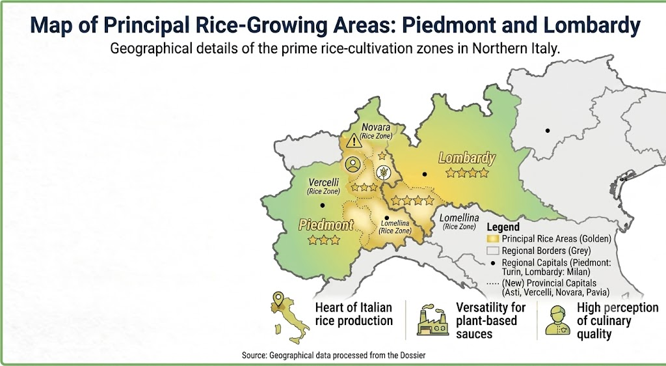
Italy is the European Union’s leading rice producer.
The Italian supply chain boasts agronomic expertise, high-quality varieties and a production heritage recognised internationally.
For companies wishing to promote ‘Made in Italy’, rice is a particularly attractive choice.
Soya
The soya used by the food industry often comes from international supply chains.
There are, of course, Italian and European producers, but availability depends on the specific end uses.
Oats
Oats are also grown in Italy, but their availability for specific industrial applications is more limited than that of rice.
Our assessment
When the aim is to develop a project closely linked to the Italian agri-food supply chain, rice currently offers particularly interesting opportunities.
Verdict
🥇 Rice
Round 6 – Industrial Versatility
An innovative raw material must be adaptable to different markets.
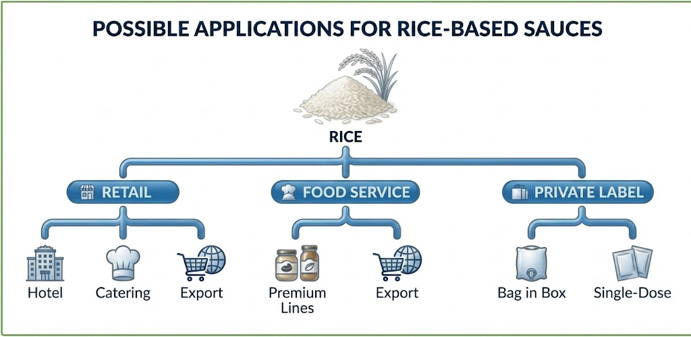
Modern sauces are, in fact, distributed through a wide variety of channels.
Retail.
Food Service.
Hospitality.
Private label.
E-commerce.
Rice enables the development of products for all these markets.
Recipes can be customised.
Packaging formats can vary.
There are numerous applications.
From premium jars to single-serve sachets.
From doypacks to bag-in-boxes.
This flexibility makes rice a particularly attractive platform for food innovation.
Verdict
🥇 Rice
What does the comparison reveal?
The comparison does not identify a ‘best’ ingredient in an absolute sense.
Soya, oats and rice will all continue to play an important role in the food industry.
Each raw material has characteristics that make it suitable for specific applications.
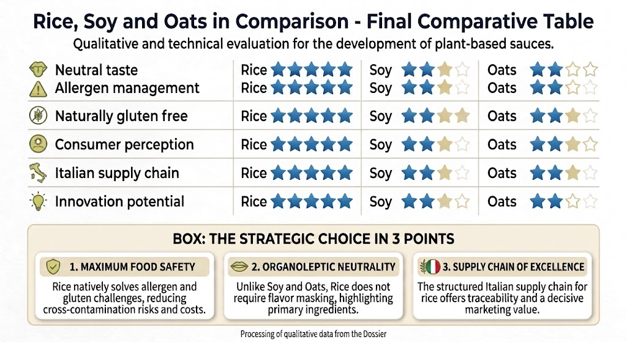
However, when the aim is to develop a modern, plant-based sauce aimed at a broad audience and one that is easy to market, rice offers a particularly attractive combination of advantages.
Its delicate flavour.
The absence of major allergens.
The fact that it is naturally gluten-free.
The strength of the Italian supply chain.
Its great versatility in applications.
These are factors that deserve attention from food companies and the rice industry.
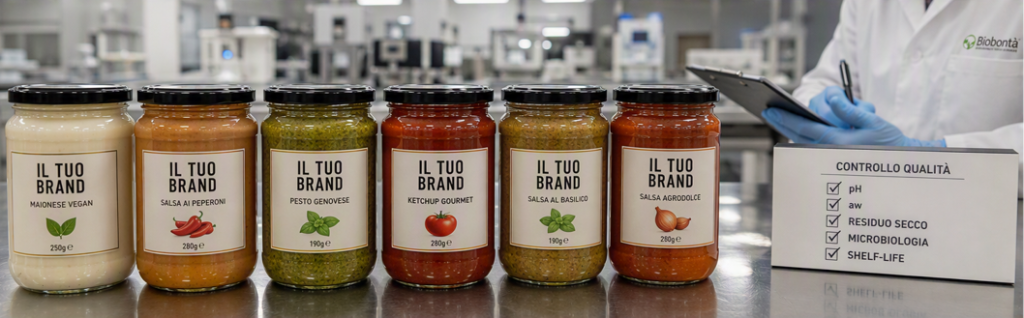
The Biobontà Case
At Tuttovo, we have chosen to invest in rice because we believe it is one of the raw materials with the greatest potential for development in the sauces sector.
This research has led to the creation of Rice Mayonnaise, Black Rice Mayonnaise and a range of vegetable-based sauces developed for the retail sector, food service and private-label projects.
We do not present rice as an alternative to other ingredients.
We present it as a new opportunity for innovation within the Italian agri-food sector.
FAQ
Why use rice instead of soya in a sauce?
Rice has a more neutral flavour, is not one of the major food allergens, and is readily associated by consumers with a simple and natural diet.
Are rice-based sauces only suitable for vegans?
No. They can appeal to a much wider audience, including families, the catering sector, hotels, the retail sector and consumers looking for innovative products.
Is rice naturally gluten-free?
Yes. Rice is naturally gluten-free. As with any food intended for coeliacs, however, it is essential to ensure there is no cross-contamination during production.
Why does rice represent an opportunity for the rice industry?
Because it allows an excellent raw material to be transformed into high value-added products, expanding a company’s product range and creating new commercial opportunities.
Key ideas
- The comparison between rice, soya and oats is not intended to declare an outright winner.
- Each ingredient has its own specific characteristics.
- Rice offers a particularly balanced combination of neutral flavour, ease of communication, an Italian supply chain and technological versatility.
- Rice-based sauces could represent a new category of high value-added products.
- For the food industry and the rice sector, innovation means creating new markets based on a raw material already recognised for its quality.
Conclusions
Innovation often stems from a simple question.
Can we use a traditional raw material in a completely new way?
In the case of rice, the answer seems to be yes.
For centuries, it has been a staple on our tables.
Today, it can also become the starting point for a new generation of sauces, capable of meeting the needs of a market that demands plant-based, innovative, sustainable products with high added value.
For the rice industry, this development represents much more than a technological curiosity.
It could become a new opportunity for growth.
Because the future of Italian rice will not depend solely on the quality of its cultivation.