Beyond "plant-based": a conscious technological choice
The food sector is undergoing a phase of profound transformation.
While the initial focus was “vegetable vs. animal,” today the debate has shifted to food processes, structures, and transformations.
Not all plant products are automatically better.
The real discriminator is how a food is built.
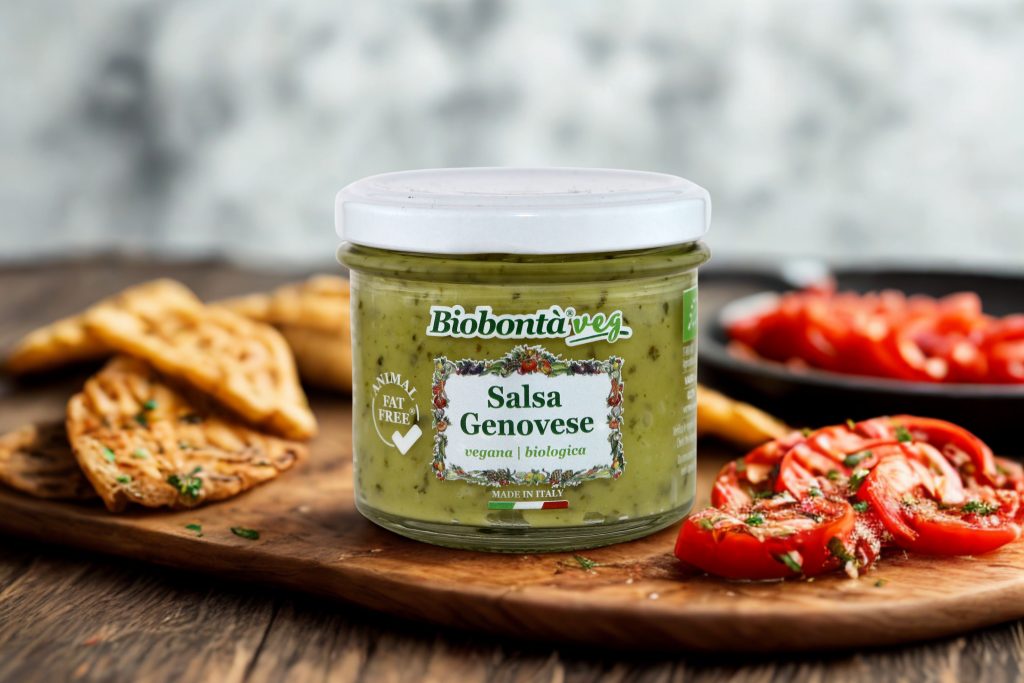
The Animal Fat Free ® line, developed by Biobontà, was born precisely from this awareness:
reduce industrial complexity, maintaining high sensory performance.
What "without ultraprocessing" really means
According to the NOVA classification, ultraprocessed foods are characterized by:
- numerous ingredients
- massive use of functional additives
- artificial reconstruction of
food matrices
Many vegetable sauces currently on the market fall into this category:
- isolated proteins
- recomposed fibers
- synthetic emulsifiers
- masking aromas
Animal Fat Free® sauces take the opposite approach
continuous food structure
few functional ingredients
no molecular reconstruction
From a technological point of view, this means something very precise: 👉 simple emulsions, not restructured systems
The emulsion: a natural colloidal system
An emulsion is a two-phase colloidal system in which two immiscible liquids (typically water and oil) are stabilized by:
mechanical energy
an emulsifying agent
Classic mayonnaise is the perfect paradigm:
aqueous phase
lipid phase
mechanical emulsification
physical, non-chemical stability
📌 Animal Fat Free® uses exactly this principle, avoiding:
forced texturing
artificial gelling
extrusion or forced fractionation processes
Why giving up soy is a complex technical choice
From an industrial point of view, soy is an “easy” emulsifier:
functional proteins
natural lecithins
excellent stability
But it has known critical issues:
declarable allergen
recognizable aromatic profile
strong industrial standardization
Animal Fat Free ® is soy-free
This choice forces:
rethink the structure of the emulsion
work on physical and non-chemical parameters
accept a real technological challenge
It is not an ideological renunciation, but a scientific stance.
Rice as an emulsifying matrix: difficulties and advantages
Using rice as the base of a sauce is technically complex.
Rice is mainly made up of:
starch (amylose + amylopectin)
very low functional protein content
Why it is difficult to emulsify with rice
absence of lecithins
low amphiphilic capacity
need for fine viscosity controlIn this context, the stability of the emulsion does not derive from additives, but from:
granulometric distribution
equilibrium between aqueous and lipid phase
mechanical process controlThis makes the product intrinsically closer to a culinary preparation than to an industrial reconstruction.
Nutritional and sensory implications
From a sensory point of view:
continuous texture
clean mouthfeel
absence of leguminous aftertastesFrom a conceptual point of view:
fewer ingredients ≠ less taste
more structure ≠ more industrial complexityThe result is a sauce that:
it behaves like a traditional sauce
it dialogues well with real food
does not cover, but accompanies
Animal fat-free® as a cultural proposition in modern food
This line is not created to imitate meat, eggs or animal derivatives.
It was born to redefine the very concept of modern sauce:
consistent with a daily kitchen
compatible with allergenic needs
technologically sober
sensorially complete
Biobontà: food technology with responsibility
The Animal Fat Free® project confirms Biobontà’s positioning:
attention to the structure of the food
respect for the raw material
rejecting ultraprocessing as a shortcut
The future of taste is no longer artificial.
It’s technically cleaner.